When to Hire a Book Coach vs. a Developmental Editor
How to get the best book support when you need it

Short answer:
Hire a book coach when you're still writing the book—when you're stuck, unsure how to structure your stories, ideas and messages, missing accountability, or staring at a half-finished draft you can't seem to finish. A book coach will also help you through the process, supporting you to clear the blocks in your way and make the most out of this experience.
Hire a developmental editor when you have a complete draft and need an expert to assess it and show you how to make it stronger. You’ve taken the manuscript as far as you can take it, and it’s ready for expert feedback.
A coach helps you get the book out of you. A developmental editor helps you elevate the book once it exists. Many transformational non-fiction and memoir authors end up using both—a coach to complete a finished draft, then a developmental editor to refine it before submitting or publishing.
If you're writing a memoir or a transformational nonfiction book and you're not sure which one you need, the rest of this guide walks you through the difference, the signs that point to each, and how to choose.
What does a Book Coach do?
A book coach is a writing partner and source of indispensible process support who works alongside you while you write. The relationship is ongoing rather than one-and-done, and it's as much about you as it is about the manuscript.
A good book coach helps you:
Clarify your big idea, your reader, and the transformation your book promises
Build a structure or outline before you're lost in the weeds
Set a realistic writing rhythm and stay accountable to it
Work through self-doubt, overwhelm, and the emotional weight that memoir and personal-growth writing often stir up
Offer support through the transformational journey that writing a book is for authors (learn more about the Alchemy of Authorship here)
Make craft decisions in real time, chapter by chapter, instead of writing 60,000 words in the wrong direction
For memoir and transformational nonfiction especially, coaching matters because the material is personal. You're not just organizing information you're deciding how much of your story to tell, how to turn lived experience into something a reader can use, and how to stay standing while you do it.
As a transformational guide who has walked with hundreds of authors (and written a whole book about the process), I know what it takes to bring people through the process of writing their first draft, not just the nuts and bolts of the process but the personal journey that this project requires. So many of my clients exclaim that they’d never have written their books without me. I am so grateful to provide this support to our clients at Whale Song, and I would love to support you!
Through book coaching, we also offer real time editorial feedback on your writing as you go, which takes SO MUCH of the headache and side questing out of this process. You end up producing a much stronger first draft than most develop without support.

What does a developmental editor do?
A developmental editor (sometimes called a "big-picture" or "substantive" editor) steps in once you have a finished draft. We read the whole manuscript and assess it at the level of structure, argument, narrative arc, pacing, and clarity. This is big work that authors can’t afford to skip over.
With our developmental editors at Whale Song, you’ll receive:
A detailed editorial letter laying out what's working and what isn't and our best advice for where to focus to strength your manuscript
Specific, prioritized guidance on structure, flow, and level of engagement for your reader
For memoir: feedback on arc, scene vs. summary, theme, and emotional throughline
For transformational nonfiction: feedback on your framework, the logic of your chapters, the structure, your delivery on your promise, your scope, and whether the promised transformation actually lands
A roadmap for your revision
A developmental edit is diagnostic and directional. It's not line-by-line wordsmithing (that's copyediting), and it's not proofreading. It tells you what to fix and why, so your revision is purposeful instead of guesswork.

What's the difference between a book coach and a developmental editor?
The simplest way to see it: a coach works with you during the writing; a developmental editor works on the draft after it's written.
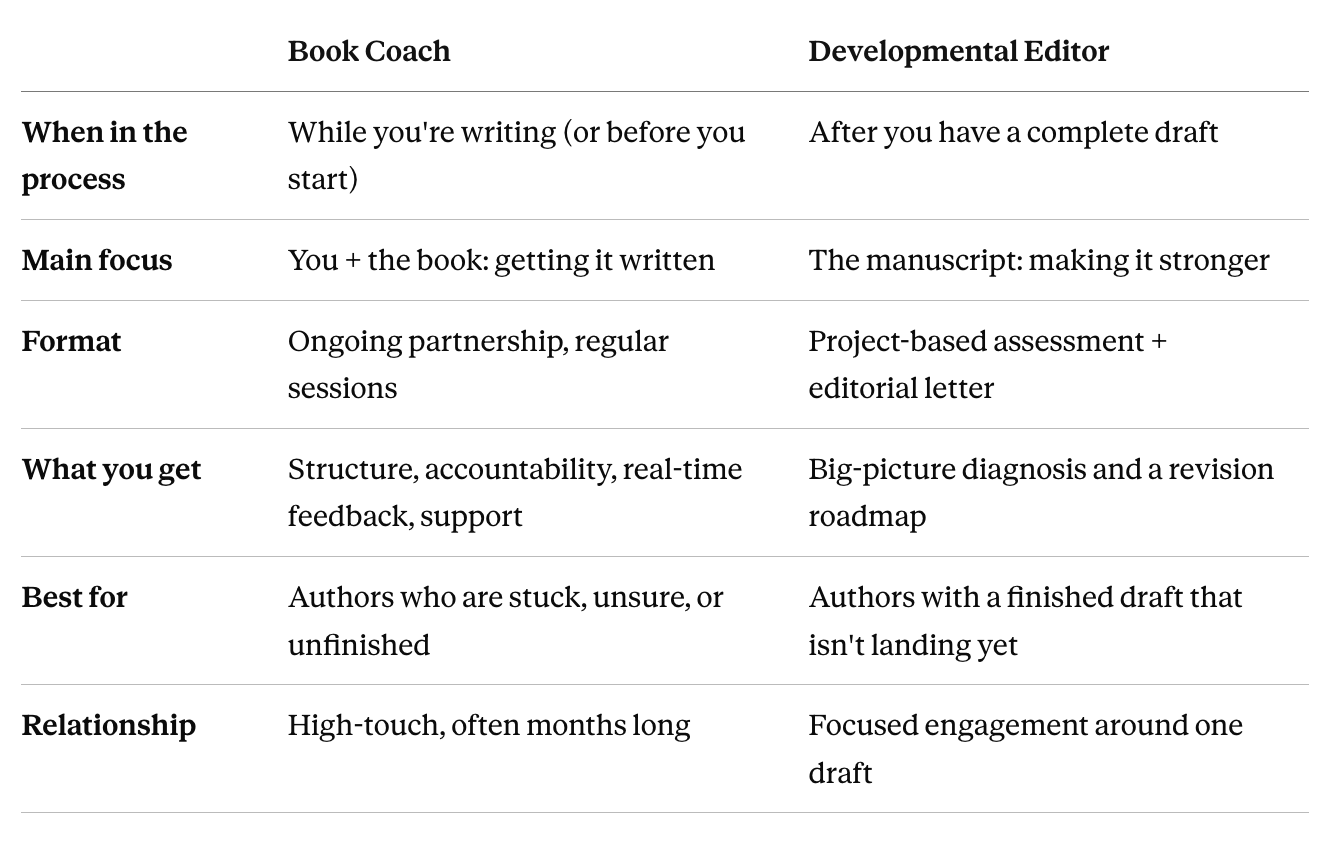
There's overlap — both care deeply about structure and your reader — but the timing and the relationship are what separate them.

How do I know which one I need?
Use this quick gut-check.
You probably need a book coach if:
You haven't finished a draft (or haven't started)
You keep restarting, or you've stalled and can't get moving again
You don't know how to structure your memoir or organize your nonfiction book
You're overwhelmed by the emotional side of telling your story, or the personal specifics like self doubt, perfectionism, struggle staying consistent in your writing process, and the like.
You need someone in your corner
You probably need a developmental editor if:
You have a complete draft
You sense something is "off" but can't name it
Readers say they like it but you're not sure it's working
You're preparing to submit to a publisher, enter a contest, or self-publish and want it to be its strongest first
You've been rejected and don't know why
You may want both, in sequence: coach to a finished draft then developmental edit to refine it before it goes out into the world. This is a common path for serious transformational and memoir authors. Most of our clients go through this process.

Can the same person do both?
Yes and it can be an advantage. An editor who has coached you already knows your story/messages, your voice, and your goals, which makes their developmental feedback sharper and faster to act on. Whale Song offers both, either coaching and editing with one of our team members or, if an author prefers, we can bring in a new editor to offer complementary feedback and new insight into your manuscript during your developmental editing phase. This makes Whale Song unique, in that we are able to offer both continuity of support and a collaborative team approach. In either case, you are not just another client, we take the time to get to know you and your work deeply, to provide a deep level of feedback and support.
How much do a book coach and a developmental editor cost?
Pricing works differently for each.
Book coaching is structured as single sessions, and time-based packages (such as 3 or 6 month programs with a set number of calls and review material word count thresholds), which can span the length of your writing process as you need it. You can learn more about our book coaching services here.
For developmental editing we charge based on word count, because this is a most accurate and fair way to assess the time and level of investment needed for your project.
Developmental work on a full-length book is a meaningful investment, typically in the four-figure range, because it's deep, expert work on your most important asset. You can learn more about our editing services here.
Ready to figure out your next step?
If you’d like to speak with our team about your project and the best support for you, please complete this intake form. Someone will be in touch within 1-2 business days and we will be happy to provide all the information and support you need determining the kind of book coaching or developmental editing you’d benefit from most.
We also encourage you to take a look at our past projects and what other authors have said about working with us.
Frequently asked questions
Is a book coach the same as a ghostwriter?
No. A ghostwriter writes the book for you. A book coach helps you write your own book: the words, ideas, stories, and voice stay yours.
Do I need a developmental edit if I'm self-publishing?
Absolutely. It's arguably even more important. With no publisher's editorial team behind you, a developmental edit is how you ensure your book is structurally sound before it's permanent.
Should I get a developmental edit before submitting to a publisher or a contest like the Hay House Writer's Contest?
For a competitive submission, yes — a strong proposal or manuscript stands out, and developmental feedback (and proposal coaching) is often what separates a winning submission from a passed-over one. We have helped dozens of people write strong book proposals for the Hay House Contest, some of which have gone on to place or win the award.
What comes after a developmental edit?
After a developmental edit, you take the suggestions and revise your draft the way you choose to, then you hire a copyeditor (sentence-level polish), then proofreader (final error check) if you are self-publishing. If you are seeking to traditionally publish, we recommend completing a developmental edit, then turn your attention to writing the book proposal and submitting that to publishers and agents.
Either way, developmental editing is the first and most important editorial stage.